what are you looking for?

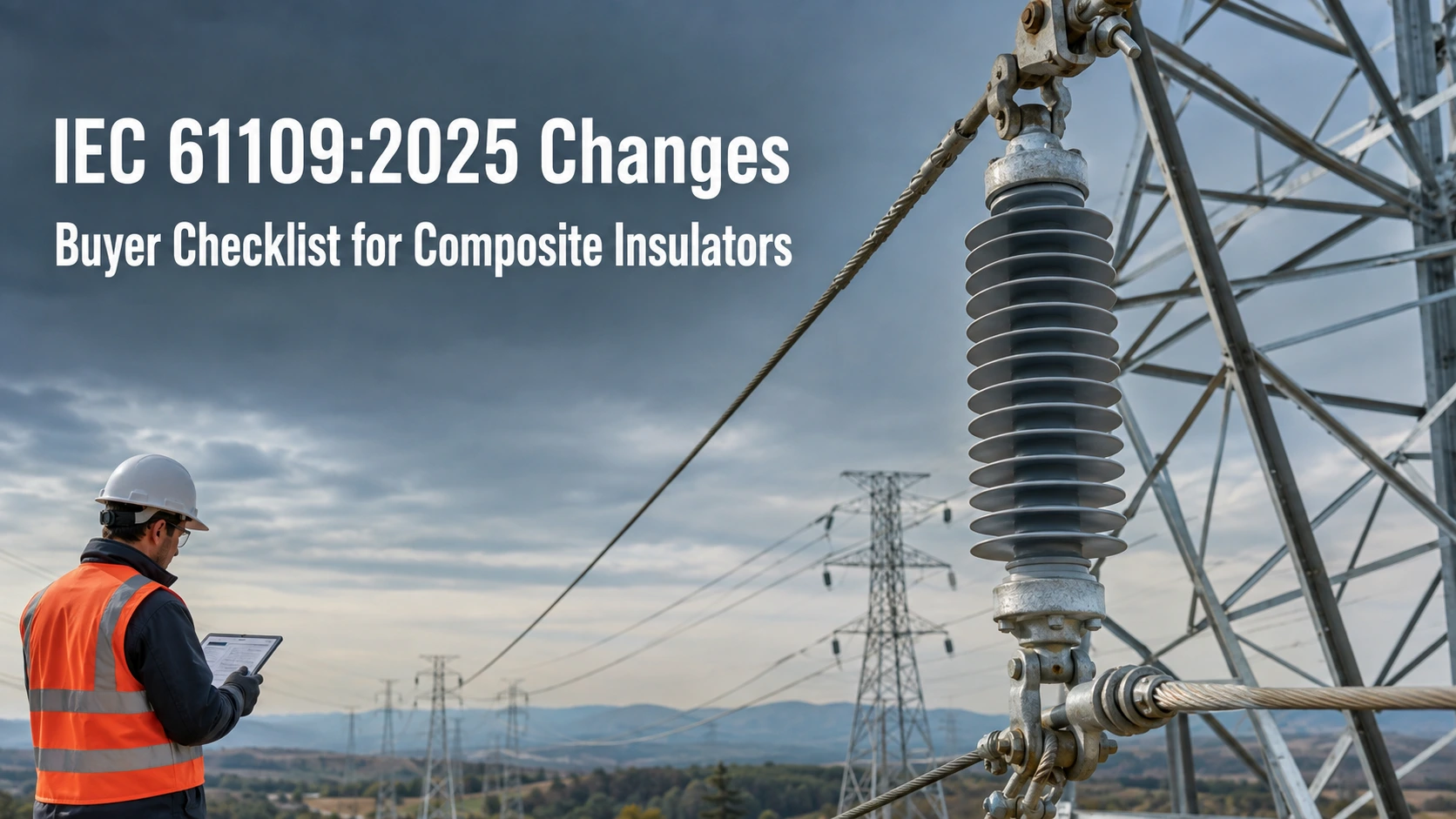
IEC 61109:2025 changes how buyers should evaluate composite suspension and tension insulators for overhead lines. A quotation that merely states “IEC 61109 compliant” is no longer enough. Procurement teams need to confirm the standard edition, application, product design, test-report coverage, mechanical requirements, end fittings, and any differences between the tested design and the product being ordered.
This review is particularly important when purchasing new polymer composite insulators, replacing an existing line insulator, approving a new supplier, or adapting an AC design for a DC project.
The first step is to confirm that the requested product falls within the standard’s scope. According to the official IEC 61109:2025 publication, the standard applies to composite suspension and tension insulators used on overhead lines with AC voltage above 1,000 V or DC voltage above 1,500 V.
These insulators have a load-bearing cylindrical solid core, normally made from fibers in a resin-based matrix, a polymeric housing around the core, and metal end fittings permanently attached to it. The standard defines relevant terminology, test methods, and acceptance criteria.
IEC 61109:2025 primarily covers composite insulators that suspend a conductor or carry tensile load in an overhead line. Typical purchasing searches include “IEC standard composite suspension insulator,” “polymer tension insulator for overhead lines,” and “IEC 61109 insulator test requirements.”
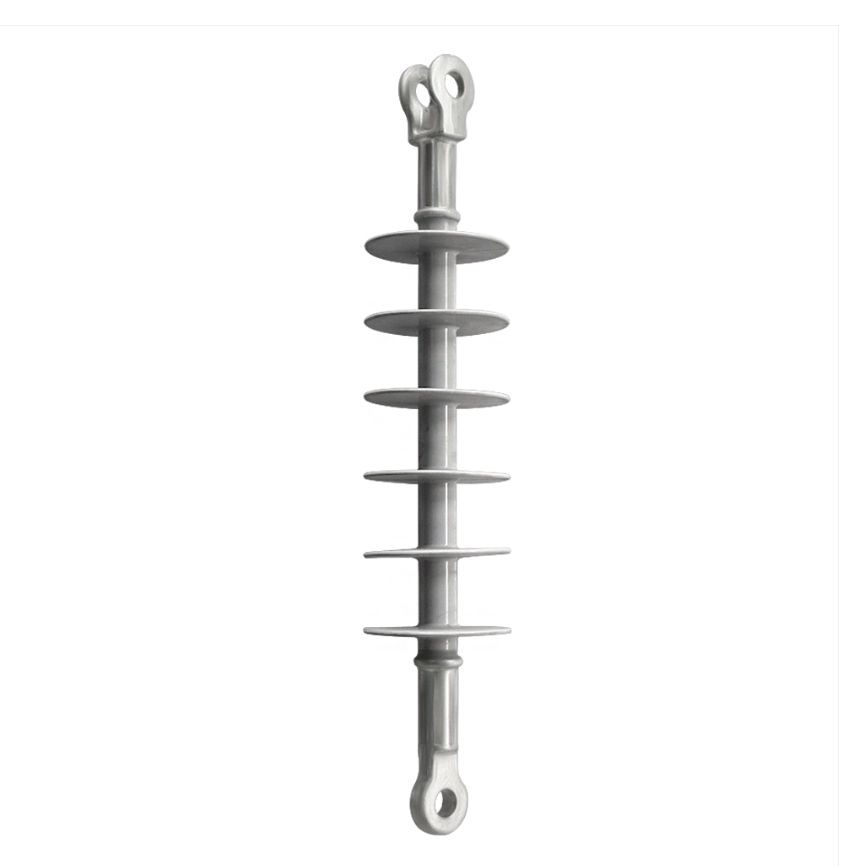
The product may occasionally experience compression or bending, such as when used as an interphase spacer, but these loads require additional engineering review. Buyers should not assume that a tensile rating alone proves suitability for an application involving significant bending or compression.
Before requesting a quotation, identify the operating voltage, AC or DC system, suspension or tension function, mechanical loading, installation geometry, end-fitting configuration, and environmental conditions. A standard reference cannot replace these project-specific details.
IEC 61109:2025 should not automatically be applied to every product described as a composite or polymer insulator. Line-post insulators, station-post insulators, hollow-core insulators, railway-specific products, and hybrid designs may be governed by different or additional standards.
One notable 2025 change is the removal of the previous clause on hybrid insulators. Therefore, a buyer sourcing an insulator with a ceramic core and polymeric housing should not assume that a previous IEC 61109 reference remains sufficient.
When the product type is uncertain, request a cross-sectional drawing, material description, intended mounting arrangement, and applicable-standard declaration. This prevents a supplier from using a broad “composite insulator” label for a product outside the document’s actual scope.
IEC 61109:2025 is the third edition and replaces the 2008 second edition. The revision is more than an administrative update. It changes the scope, test framework, design-change assessment, and guidance relevant to both AC and DC composite insulators.
| Area | What Buyers Need to Check |
|---|---|
| AC and DC scope | Confirm whether the project is AC or DC and whether the submitted evidence covers that system. |
| Hybrid insulators | Hybrid insulators were removed from the document’s scope and require separate standards review. |
| Test procedures | Check whether referenced procedures and acceptance criteria correspond to the 2025 edition and related IEC documents. |
| Interfaces | Verify how the core, housing, and end-fitting interfaces are represented in the tested design. |
| Design or type test repetition | Determine whether changes in materials, dimensions, manufacturing process, or interfaces require tests to be repeated. |
| Electrical type tests | Confirm that the report uses the applicable test configuration and electrical requirements. |
| Sample-test retesting | Review the revised retesting procedure instead of relying on an old inspection template. |
| AC electric-field control | Evaluate whether grading or corona-control provisions are relevant to the assembly. |
| Core-to-housing adhesion | Check whether the design evaluation addresses mechanical adhesion between these components. |
| DC applications | Ask for evidence specifically applicable to DC rather than accepting an AC report without review. |
The new annexes provide guidance on AC electric-field control, typical composite-insulator assemblies, mechanical evaluation of adhesion between the core and housing, and the applicability of design and type tests to DC products. These changes make the interfaces and complete assembly more important in procurement evaluation.
Buyers do not need to reproduce laboratory procedures in an RFQ. They do, however, need to identify which revision governs the project and ask the supplier to explain how its documentation supports the proposed design.
A test report is useful only when it can be connected to the product offered. The document title and IEC reference are starting points, not complete evidence.
Compare the report with the supplier’s drawing and datasheet. Check the manufacturer’s name, product designation, core construction, housing material, interface design, end fittings, dimensions, specified mechanical load, and electrical characteristics.
Particular attention should be given to changes that may affect the validity of design or type tests. A different core diameter, housing formulation, attachment method, end-fitting design, interface, or manufacturing process may require technical assessment and possibly additional testing. Whether retesting is required depends on the nature of the change and the applicable provisions of the standard.
A report for a visually similar insulator should not be accepted automatically. Ask the supplier to provide a written explanation of how the tested design relates to the quoted product and to identify any differences.
Different test categories answer different purchasing questions. Design tests address the suitability of a design, materials, and interfaces. Type tests verify important characteristics of an insulator type. Sample tests apply to selected units from a lot, while routine tests are performed according to the applicable requirements for production units.
The RFQ or inspection plan should state which reports, certificates, inspection records, and shipment documents are required. Buyers reviewing CECI may consult its available test reports and certificates as an initial reference, but the applicability of any document to a specific model, project, and IEC edition still needs to be confirmed before an order is approved.
The document review should record the test laboratory, report number, issue date, standard edition, tested designation, tested configuration, acceptance result, and any limitations or remarks.
Most procurement problems arise because a general compliance statement is accepted before the exact product configuration has been finalized.
A supplier may submit a valid report based on IEC 61109:2008 when the project specification calls for the 2025 edition. This does not automatically mean the product is unsuitable, but the difference must be identified and resolved. The buyer should request a gap assessment showing which 2025 requirements are covered, which have changed, and whether supplementary evidence is necessary.
Another risk occurs when the test report covers one end-fitting combination or mechanical rating while the quotation proposes another. To reduce ambiguity, place the approved drawing number and revision, product designation, applicable standard, and required document list in the purchase specification.
IEC 61109 compliance does not by itself determine the correct creepage distance, mechanical load, fitting connection, insulation distance, shed profile, or electric-field-control arrangement for every site.
Selection still depends on the system voltage, line configuration, pollution severity, altitude, environmental exposure, conductor load, installation position, existing hardware, and project requirements. For replacement orders, the maintenance team should provide drawings, dimensions, photographs, marking information, and details of the original failure or mismatch.
The buyer must also verify compatibility between the insulator end fittings and the surrounding line hardware. A compliant insulator with an incompatible ball, socket, clevis, eye, tongue, or other connection can still cause installation delays or require unplanned adapters.
A complete request for quotation helps the supplier determine whether an existing design is suitable and which documents should accompany the proposal. Include the following information:
If information is missing, label it for technical confirmation rather than allowing an assumption to become part of production. This is especially important for replacement projects, where two insulators can appear interchangeable but differ in connection dimensions, mechanical performance, arcing distance, or installation orientation.
The broader how to evaluate a composite insulator manufacturer guide can support supplier comparisons involving product matching, documentation, quality control, fittings, packaging, and delivery coordination.
A suitable supplier should be able to connect three items clearly: the customer’s application, the proposed product drawing, and the supporting compliance documents. Procurement teams should look for precise answers about the standard edition, test-report applicability, material or dimensional changes, production inspection, end-fitting compatibility, and required shipment records.
Vague claims such as “made to IEC standards” should be replaced with identifiable documents and an approved specification. A supplier should also be willing to flag applications that require additional engineering review instead of treating one catalog design as suitable for every project.
China Energy and Chemical Industry Co., Ltd., operating under the CECI name, presents high-voltage insulators and power grid hardware for transmission, distribution, substation, and related applications. Its published product range includes composite insulators, insulator components, and overhead-line hardware. This combination is relevant when buyers need to review both the insulator and its connection to surrounding fittings.
CECI’s product pages include suspension, pin, post, line-post, and railway-related composite-insulator options. Because these products do not all fall under IEC 61109, the applicable standard and supporting evidence should be confirmed model by model. That distinction helps keep a technical inquiry accurate and prevents a general product-category claim from being mistaken for project-specific compliance.
IEC 61109:2025 gives buyers an updated basis for evaluating composite suspension and tension insulators, including DC applications, design interfaces, test repetition, electrical testing, core-to-housing adhesion, and assembly considerations. The practical purchasing task is to connect the correct standard edition with the exact product design and operating conditions.
For a technical review or quotation, prepare the system voltage, AC or DC application, mechanical load, creepage requirement, end-fitting configuration, drawings, quantity, operating environment, destination, and required test documents. Buyers can then contact CECI to discuss whether an available composite-insulator configuration matches the project or requires further confirmation.
IEC 61109:2025 covers composite suspension and tension insulators for overhead lines above 1,000 V AC or 1,500 V DC. The covered construction includes a load-bearing solid insulating core, polymeric housing, and permanently attached metal end fittings.
It may provide useful evidence, but it should not automatically be treated as proof of compliance with IEC 61109:2025. Buyers should request a documented comparison of the editions and determine whether changed requirements or product-design differences require additional evaluation or testing.
Compare the manufacturer, model, drawing, materials, core and housing design, interfaces, dimensions, end fittings, mechanical rating, electrical characteristics, and standard edition. Any differences should be identified and technically assessed before order approval.
Not generally. IEC 61109:2025 is focused on composite suspension and tension insulators. A line-post, station-post, hollow-core, hybrid, or railway-specific insulator may require another standard or a combination of project requirements.
Send the voltage and system type, application, mechanical load, creepage requirements, end-fitting details, drawings or photographs, operating environment, quantity, destination, required standard edition, inspection requirements, and test-document list.

 Room 1502, NO.12, Shangwu Waihuan Road, CBD, Zhengzhou, China
 +86-18937178812
 sales@gridinsulators.com


 August 20, 2026