what are you looking for?

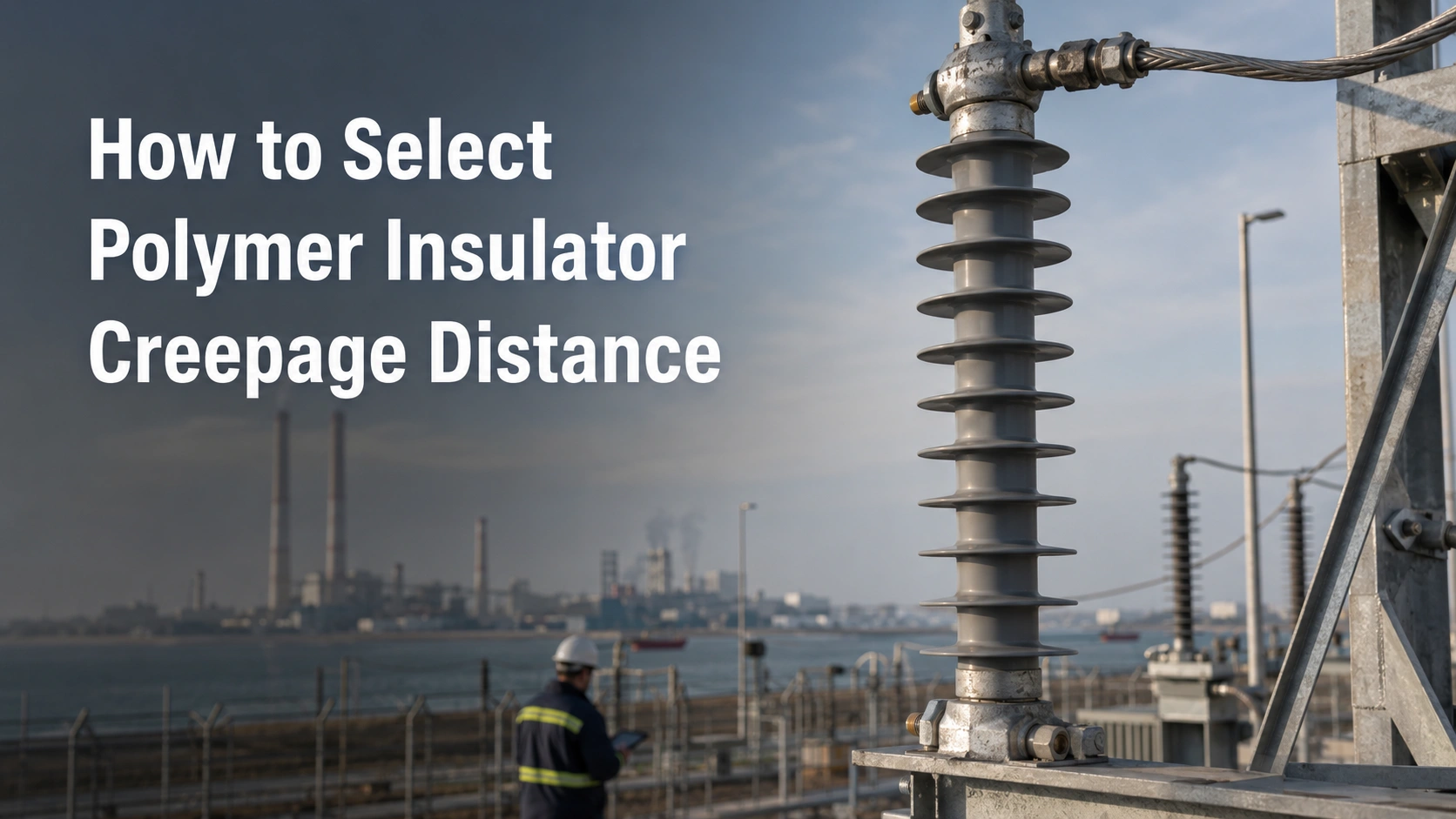
Selecting polymer insulator creepage distance is not a matter of matching one voltage class to a fixed mm/kV value. Pollution type, wetting conditions, altitude, insulator diameter, shed profile, mounting position, material behavior, and local service experience can all change the requirement. IEC TS 60815-3:2025 provides a structured method for moving from site pollution severity to a candidate insulator’s unified specific creepage distance. For engineers and B2B buyers, the practical objective is to translate that method into a product specification that suppliers can review, quote, and document.
The official IEC publication states that IEC TS 60815-3:2025 applies to the selection and dimensioning of polymeric insulators for outdoor high-voltage AC systems with respect to pollution. It supports three main tasks: determining reference unified specific creepage distance, selecting an appropriate profile, and applying corrections for the candidate insulator.
Part 3 can support outdoor AC applications involving polymer suspension, tension, line-post, station-post, or apparatus insulators, provided the product and installation fall within the specification’s scope. The actual selection still depends on the insulator function and project requirements.
It should not be applied automatically to DC systems, controlled indoor insulation, or projects where snow and ice are the main environmental concern. IEC TS 60815-4 addresses DC insulators, while ceramic and glass AC insulators are handled through Part 2. Buyers working with conventional insulation can review the corresponding creepage distance calculation for glass suspension insulators without mixing that method into the polymer-insulator specification.
Two lines with the same system voltage can require different insulation designs. A coastal line may experience repeated salt deposition and fog wetting, while an industrial location may collect soluble chemicals and non-soluble dust. Desert installations can combine sand, low rainfall, condensation, and difficult cleaning access. These conditions affect surface conductivity and pollution flashover risk differently.
Before calculating USCD for polymer insulators, determine how contamination reaches the insulator and how it becomes wet. Relevant information includes distance from the sea or an industrial source, prevailing wind, rainfall, fog, dew, cleaning intervals, and previous flashover records.
Site pollution severity should be established using the applicable IEC TS 60815-1 approach, utility requirements, measurements, and credible local experience. A description such as “heavy pollution” is not sufficient by itself. Buyers should ask what pollution source exists, whether measurements are available, how comparable insulators have performed, and whether the proposed SPS class reflects the actual installation position.
RUSCD and USCD describe different stages of the selection process. RUSCD is associated with a reference insulator and the selected site pollution severity. Candidate USCD is the value used after considering the characteristics and operating conditions of the proposed polymer insulator.
The process begins under IEC TS 60815-1:2025. Project teams collect system, application, environmental, and site-performance information to establish an SPS value or class. That result is then used to determine the reference RUSCD through the applicable standard or project specification.
When measurements and service experience disagree, the difference should be investigated instead of selecting the lower requirement for convenience. Check whether the measurements represent the correct pollution season, wetting process, installation orientation, and reference-insulator type. If the available data cannot support a reliable SPS decision, the RFQ should identify the classification as pending technical confirmation.
IEC TS 60815-3:2025 introduces or revises the corrections used to move from reference RUSCD to candidate-insulator USCD. These include altitude, average diameter, shed profile, installation position, and the number of parallel insulators.
The supplier therefore needs more than a voltage rating. A useful technical submission should identify the housing profile, shed spacing, relevant diameters, insulating length, mounting arrangement, and total creepage distance. Two products with the same leakage distance may not perform identically if their profiles collect and retain contamination differently. Selection should consider how effectively the available creepage path can operate under the expected pollution and wetting conditions.
The 2025 specification introduces hydrophobicity transfer and hydrophobicity transfer material, or HTM, more explicitly into polymer-insulator selection. It recognizes that reduced creepage distance may be considered for HTM insulators, but this is not an automatic allowance for every polymer housing.
Silicone rubber is commonly associated with hydrophobic behavior, but the material name alone does not establish the hydrophobicity transfer performance required for a specific design decision. Material formulation, surface condition, contamination, aging, electrical stress, and operating environment may influence actual behavior.
Before accepting reduced creepage distance, ask the supplier to identify the housing material, explain the basis for treating it as HTM, and provide the applicable supporting documentation. A conservative approach is appropriate when evidence is incomplete, the site experiences persistent wetting or extreme pollution, or the consequences of flashover are high. Reduced creepage should be a documented engineering decision, not a catalog assumption.
After candidate USCD has been established, it must be converted into a total creepage-distance requirement and compared with real products.
Total creepage distance is obtained by applying the candidate USCD to the appropriate RMS value of the highest operating voltage across the insulator, as defined by the governing standard and project. Nominal line voltage should not be substituted without checking the voltage basis.
Keep units consistent and record every correction used. The final specification should show the required minimum value, the proposed product value, the calculation assumptions, and any design margin required by the utility or project.
Buyers can then compare the result with available polymer composite insulators. CECI lists suspension, pin, post, line-post, and other composite-insulator configurations, but the dimensions and standards applicable to a particular model should be verified against its current drawing and technical specification.
Adequate creepage distance does not prove that an insulator fits the line. Confirm dry arcing distance, insulating length, overall section length, shed profile, mechanical rating, mounting direction, and tower or pole clearance.
Replacement projects also require matching end fittings and connection dimensions. An insulator can satisfy the electrical calculation yet create an installation problem if its eye, clevis, tongue, ball, socket, base, or mounting orientation differs from the existing hardware. Submit drawings and field measurements before production rather than relying on product photographs.
The following checks can prevent many specification and quotation problems:
| Selection error | Main risk | Preventive action |
|---|---|---|
| Selecting by nominal voltage alone | Pollution conditions remain unaddressed | Confirm SPS and the correct voltage basis |
| Copying an old fixed mm/kV value | Candidate-insulator corrections are omitted | Use the RUSCD-to-USCD process |
| Treating all silicone rubber as HTM | Creepage distance may be reduced without evidence | Request material and performance documentation |
| Assuming more creepage is always better | Closely spaced sheds may not use the path effectively | Review profile, spacing, and pollution type |
| Ignoring dry arcing distance and fittings | Electrical or installation requirements may not be met | Approve a complete product drawing |
| Applying Part 3 to DC systems | The wrong selection method is used | Review IEC TS 60815-4 |
These checks should be completed before comparing unit prices. Otherwise, suppliers may quote different designs based on different assumptions, making the commercial comparison unreliable.
Repeated pollution flashover can indicate insufficient leakage distance, but it can also result from an unsuitable profile, uneven contamination, loss of surface hydrophobicity, housing damage, unusual wetting, or inadequate cleaning practices.
Before changing the specification, record where the flashover occurred, the weather and wetting conditions, contamination pattern, surface tracking or erosion, cleaning frequency, and the orientation of the installed unit. Compare affected and unaffected phases or structures where practical.
Maintenance teams should provide photographs, existing product markings, dimensions, fitting details, and previous inspection records. If the problem is concentrated around damaged housing or a poorly protected interface, simply ordering a longer creepage distance may not address the cause. The next step should be a combined review of the environment, product condition, profile, electrical clearances, and maintenance history.

A qualified supplier should be able to connect the project conditions, calculation assumptions, proposed drawing, and supporting documents. China Energy and Chemical Industry Co., Ltd. presents high-voltage insulators and power grid hardware under the CECI brand, including several polymer-insulator product types relevant to transmission, distribution, and substation inquiries.
A useful RFQ should include:
AC system and highest operating voltage;
insulator function and installation orientation;
SPS class and supporting site information;
target USCD and total creepage distance;
altitude and relevant environmental conditions;
required dry arcing and section lengths;
mechanical load and end-fitting configuration;
drawings, existing model data, or replacement photographs;
quantity, destination, and required technical documents.
If one of these items is unknown, mark it for technical review. Do not allow the supplier to assume a pollution class or installation arrangement without recording that assumption.
Ask the supplier to show how the proposed product relates to the stated SPS, RUSCD, corrections, and required total leakage distance. The submission should identify the product drawing, housing material, profile dimensions, applicable standard edition, and any deviations from the RFQ.
Buyers comparing several sources can also review how to evaluate a composite insulator manufacturer for broader criteria involving application matching, technical communication, document control, end fittings, inspection expectations, and delivery coordination. CECI product information can support an initial model discussion, but final creepage distance, HTM status, and IEC TS 60815-3:2025 applicability should be confirmed for the selected configuration.
Polymer insulator creepage distance under IEC TS 60815-3:2025 should be selected through a documented chain: determine SPS, establish RUSCD, apply candidate-insulator corrections, assess HTM status, calculate total creepage distance, and verify the complete product geometry.
For a technical review or quotation, prepare the voltage, application, pollution environment, altitude, drawings, dimensions, fitting requirements, failure photographs, quantity, and required documents. Project teams can then contact CECI to discuss available configurations and identify which parameters still require confirmation.
Determine the site pollution severity and reference RUSCD, apply the relevant candidate-insulator corrections to obtain USCD, and multiply that value by the applicable highest operating voltage across the insulator. Verify the voltage basis and units against the project standard.
RUSCD is the reference value associated with the selected SPS class and reference insulator. USCD is the value for a candidate insulator after considering its material, profile, dimensions, installation, altitude, and other relevant corrections.
Potentially, when the housing qualifies as an HTM and the reduction is supported by appropriate engineering evidence. The words “silicone rubber” alone do not prove that a reduced value is suitable for every environment.
No. Part 3 addresses polymer insulators for AC systems. DC polymer-insulator dimensioning should be reviewed under IEC TS 60815-4 and the applicable project requirements.
Send the system voltage, AC application, SPS or pollution description, altitude, target creepage and arcing distances, mechanical load, installation orientation, fittings, drawings, existing model information, quantity, destination, and required documents.

 Room 1502, NO.12, Shangwu Waihuan Road, CBD, Zhengzhou, China
 +86-18937178812
 sales@gridinsulators.com


 August 27, 2026