what are you looking for?


For a coastal transmission project, writing “hot-dip galvanized line fittings” on an RFQ is not enough. Salt-laden moisture can attack steel, threads, joints, and interfaces in different ways. A usable RFQ must define the environment, steel or fitting material, galvanizing route, coating acceptance, fabrication details, mating hardware, inspection records, and change controls. This guide turns those corrosion concerns into fields a supplier can quote and an engineer can approve.
Line fittings carry mechanical loads and connect conductors, insulators, clamps, structures, and protective hardware. In a marine or salt-fog corridor, the zinc coating is only one part of the corrosion system. Water retention, crevices, damaged edges, incompatible metals, blocked drainage, and missing inspection evidence can all create a problem after delivery. The RFQ should therefore describe the service environment and the complete assembly, not just the nominal steel grade.
The phrase “coastal project” can mean direct sea spray, intermittent salt fog, humid inland air, or mixed marine and industrial exposure. State the actual condition so coating, geometry, and maintenance requirements can follow from it.
Start with the location and wetting pattern. Identify whether the line is open to sea spray, exposed to wind-driven salt, regularly covered by fog or dew, or sheltered by terrain. Include shoreline distance when relevant, prevailing wind, rainfall and natural washing, temperature, humidity, altitude, and UV exposure. If industrial emissions, dust, or de-icing salts are present, list them as additional contaminants rather than hiding them under the word coastal.
“Galvanized” should identify a process and an acceptance basis. State the fitting material, fabrication route, and whether the complete fabricated part will be hot-dip galvanized after fabrication. This matters because holes, edges, welds, threads, and machined areas can respond differently to preparation and immersion. Require the supplier to identify the selected material.
The RFQ should name the governing standard, coating designation, or utility specification used for acceptance. Do not rely on an unqualified phrase such as “heavy zinc coating.” Ask the supplier to state the required coating thickness or coating mass basis, measurement method, sampling plan, and treatment of local thin areas. The exact requirement belongs to the project standard and fitting geometry, not a universal number.
Also state which areas must remain functional after galvanizing. Threads, pins, clevis openings, bearing faces, and mating surfaces may need a defined fit condition, masking approach, or post-treatment check. These details prevent a coating that meets a nominal description from creating an assembly problem.
A coastal RFQ should require more than a visual statement that the surface looks silver and continuous. Define the visual acceptance limits for bare spots, runs, lumps, roughness, ash, dross, blisters, storage staining, and mechanical damage. Require the supplier to identify inspection equipment, measurement locations, record format, and lot or batch reference. If representative sampling is used, state how the sample is selected.
Treat white rust or storage staining as a defined inspection question. Require dry, ventilated packaging and review any zinc corrosion products found before shipment or assembly.
Coating quality is influenced before galvanizing. Put fabrication details in the RFQ when they affect drainage, venting, access, or coating continuity. Closed sections may need vent and drain provisions. Crevices, overlapping plates, and inaccessible pockets can retain process liquids or moisture.
Ask for the released drawing to show holes, slots, radii, welds, bends, forged transitions, threads, and any surfaces that must remain dimensionally controlled. Identify whether post-galvanizing drilling, tapping, grinding, or cutting is prohibited or requires an approved repair. If machining after treatment is allowed, define how the exposed steel or damaged zinc will be protected and inspected.
A galvanized fitting may contact aluminum conductors, stainless fasteners, copper accessories, painted steel, or an insulator end fitting. List the mating materials and identify any required washers, separators, sealants, grease, or protective coatings. The objective is to prevent an interface from becoming the weakest corrosion point while preserving the electrical and mechanical function.
Specify fastener material and coating separately from the main fitting. Confirm bolt, nut, washer, pin, and cotter-pin sizes, as well as torque or locking requirements where the design calls for them. If a fitting uses a ball-and-socket, clevis-and-tongue, eye, pin, or custom coupling, name both mating halves and their controlled dimensions.
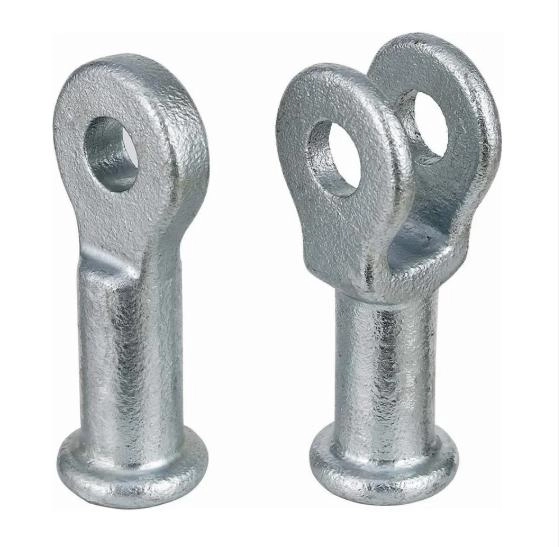
For examples of the fitting scope, see CECI’s Overhead Line Hardware Fittings and Accessories category and its 70kN tongue clevis end fitting product page.
Corrosion resistance does not compensate for a mechanically or dimensionally wrong fitting. Include rated mechanical load, conductor or insulator interface, connection type, overall dimensions, weight, orientation, and installation position. Show the load path and mating hardware on the drawing, including mounting pattern, bolt spacing, and clearance constraints.
When a fitting is part of a polymer-insulator assembly, coordinate the metal interface with the FRP or fiberglass core, silicone rubber housing, and end-fitting configuration. The approved assembly drawing should control the interface rather than a product name used in isolation.
Coastal corrosion protection can be undermined between final inspection and installation. State packaging requirements that keep fittings dry, separated, and protected from abrasion, salt contamination, and trapped condensation. Require part marking or labels that connect each shipment to the approved drawing, material record, coating batch, inspection report, and quantity.
Before mass production, approve a first article against the released drawing and RFQ. Review material identity, dimensions, coating appearance and measurements, threads and interfaces, mechanical documentation, packaging, and traceability. CECI’s quality process includes first-article inspection before each batch, with mass production after approval. If materials, molds, equipment, tooling, fittings, or process conditions change, require a documented impact review and re-validation before release.
CECI China Energy and Chemical Industry Co., Ltd. identifies electrical power fittings as components used to connect, secure, protect, and support conductors, insulators, and structures. Its product information covers galvanized steel, aluminum alloy, and ductile iron options, hot-dip galvanizing or coating, rated mechanical load, dimensions, connection type, coating thickness, and applicable project standards. The line-hardware range includes suspension clamps, tension or dead-end fittings, clevises, eye fittings, yoke plates, arcing horns, brackets, bolts, nuts, washers, and protective accessories.
When the fitting is supplied as part of a composite-insulator assembly, the Polymer Insulators product range can be reviewed together with the metal interface and line-hardware drawing.
For a technical fit check, send the location, exposure, assembly drawing, material and coating requirement, load, mating hardware, inspection plan, quantity, packaging, and change-notification expectations.
A coastal line-fittings RFQ should define the environment, name the galvanizing route and acceptance basis, control coating-critical fabrication details, address dissimilar metals, and connect corrosion requirements to load and geometry. Add inspection, repair, packaging, traceability, first-article approval, and change control so the delivered hardware remains tied to the approved design. For a project-specific review, contact the CECI technical team with the drawing, coating requirement, fitting interface, exposure conditions, and required records.
No. The RFQ should also identify the material, governing standard or designation, coating acceptance, inspection method, fabrication limits, mating materials, and repair rules.
No. The required value depends on the governing project standard, fitting geometry, exposure, and acceptance method. State the applicable basis and require the supplier to document compliance.
Check fit, dimensions, coating condition, burrs, blocked holes, and any approved masking or post-treatment requirements. The released drawing should identify functional surfaces.
Re-validation may be required after changes to materials, tooling, molds, equipment, fittings, or process conditions. The required scope should follow the project change-control plan.

 Room 1502, NO.12, Shangwu Waihuan Road, CBD, Zhengzhou, China
 +86-18937178812
 sales@gridinsulators.com


 October 1, 2026