what are you looking for?


Coastal transmission lines expose insulation systems to salt fog, humidity, wind-driven deposits, sunlight, and repeated wetting. A polymer insulator can fit this environment, but the purchase decision should connect site severity to creepage distance, shed profile, hydrophobic performance, mechanical load, end fittings, and inspection records.
Salt deposited on an insulator surface can become conductive when wet. Leakage current and dry-band activity depend on contamination, moisture, rainfall, wind, surface condition, geometry, and the available leakage path. A silicone rubber housing may provide hydrophobic behavior, but the design still has to match voltage, pollution, mechanical duty, clearances, and maintenance.
For engineers and procurement teams, the useful question is not whether polymer insulators are “for the coast.” It is which input values must appear in the specification so a manufacturer can select and verify the correct product. The sections below turn the coastal problem into an RFQ-ready checklist while keeping acceptance tied to the approved drawing and applicable project requirements.
Begin with the site, not the catalog. Record whether the line is directly exposed to sea spray, intermittent salt fog, industrial emissions, desert dust, high humidity, or a combination of contaminants. Note the distance from the shoreline, prevailing wind direction, rainfall pattern, cleaning by natural rain, and whether the line passes through a sheltered or open corridor. These conditions influence how quickly contamination accumulates and how often the surface becomes wet.
A site description does not replace an engineering pollution assessment. It gives the supplier context to verify creepage and profile instead of selecting a length by habit.
Creepage distance is the leakage path measured along the insulating surface. In a coastal application, it should be specified together with the shed profile, shed diameter, spacing, and the relevant voltage and pollution assumptions. A longer surface path is not automatically a complete solution if the geometry retains deposits, wets easily, or creates poor natural cleaning.
The RFQ should identify the required creepage distance and the dimensions that create it. Ask for the drawing value, tolerance, and measurement method. Confirm arcing distance or air clearance separately. Also check overall length, core rod diameter, shed spacing, and end-fitting position because a dimensional change can affect clearances and hardware fit.
Where a project follows a named standard or utility design practice, cite that requirement directly. If the final value depends on pollution severity, altitude, voltage, or installation position, write the requirement as a design condition to be verified, not as an unsupported universal number.
Hydrophobicity describes a silicone rubber surface’s tendency to repel water and limit a continuous conductive film. It is useful in wet pollution, but depends on formulation, aging, contamination, surface condition, and exposure. Ask how the housing and shed design are controlled and verified for service.
A “silicone rubber” label is not a substitute for a qualification or inspection plan. Match acceptance to the project specification and product configuration.
Coastal exposure does not remove transmission-line mechanical requirements. Specify voltage, mechanical failing load, bending or tensile duty where relevant, and insulator position. Wind, conductor tension, vibration, ice, hardware geometry, and installation method may affect the load path. Relate those inputs to the core, housing, and fittings on the approved drawing.
Ask for the arcing distance, overall length, shed dimensions, and core rod diameter as controlled characteristics. Confirm that the requested product can be installed without changing clearances or modifying adjacent hardware. When the line uses suspension clamps, tension fittings, yoke plates, arcing horns, or brackets, include the mating dimensions and orientation in the RFQ rather than ordering the insulator as an isolated component.
Salt fog can accelerate corrosion at exposed metal interfaces, while a fitting mismatch can create assembly delays even when the insulating body is correct. Specify the fitting type, coupling dimensions, pin or hole details, orientation, mechanical rating, material, and surface treatment. Common project requirements may include galvanized steel, aluminum alloy, or another approved material, but the final choice must follow the drawing and environmental specification.
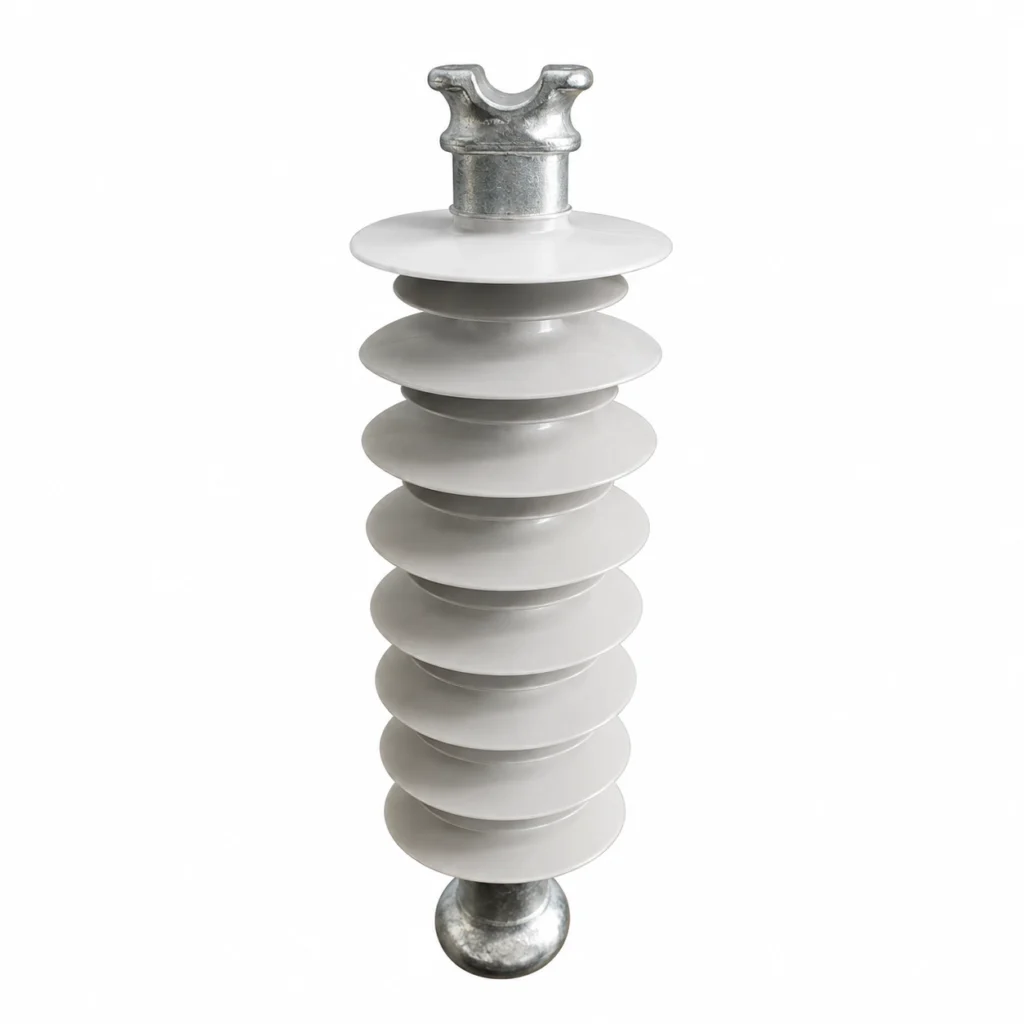
For each end fitting, define adjacent hardware and acceptance checks: seating, alignment, dimensions, surface condition, coating, fasteners, and sealing. Identify whether arcing horns or protective covers are part of the assembly or separate hardware. A clear interface schedule prevents a ball fitting from being paired with the wrong socket or a clevis from being ordered without its matching tongue and pin.
For the related hardware scope, see CECI’s Overhead Line Hardware Fittings and Accessories and Polymer Insulators product range.
A useful coastal polymer insulator RFQ lets the supplier respond against defined fields instead of guessing from a product name. Attach the line or assembly drawing when available and include the data needed for a fit check.
This detail supports comparable technical responses and reduces the risk of receiving a similar unit that needs field modification.
Before mass production, approve a first article against the released drawing and specification. For a polymer insulator, the review should cover material identity, core and housing condition, shed geometry, creepage and arcing dimensions, end-fitting interface, visual quality, and the agreed test or inspection records. The acceptance limits depend on the project and applicable standard, so the approval package should identify the actual criteria used.
The manufacturing route should remain controlled after approval. A change to materials, molds, equipment, tooling, fittings, or process conditions can affect conformity and may require re-validation. Ask the supplier to state the change-control trigger and to retain batch traceability so later replacement units can be matched to the approved configuration.
CECI China Energy and Chemical Industry Co., Ltd. identifies composite and polymer insulators as part of its power transmission and distribution offering. The product information covers FRP or fiberglass core rods, silicone rubber sheds, metal end fittings, pollution resistance, weather and UV resistance, hydrophobic performance, and applications that include coastal, salt-fog, and high-humidity areas. The final product selection remains dependent on the project voltage, mechanical load, creepage and arcing distances, dimensions, fitting type, and operating environment.
When requesting a fit check, send the drawing or model, required quantity, line application, site conditions, electrical and mechanical parameters, hardware interface, and documentation expectations. That allows the technical team to review a complete configuration rather than quote a generic polymer insulator.
A coastal transmission line specification should connect environment to design: describe the contamination and wetting conditions, set creepage with the shed profile, define the hydrophobicity and weathering evidence required, and match metal end fittings to the complete line assembly. Then use first-article approval and change control to protect the agreed configuration through mass production. For a project-specific review, contact the CECI technical team with the drawing, voltage, load, creepage, arcing distance, site conditions, fitting details, and required records.
They can be suitable when the housing, creepage distance, shed profile, mechanical rating, fittings, and verification plan match the site conditions. Suitability should be confirmed against the project specification.
No. Hydrophobic behavior and creepage distance address related but different aspects of pollution performance. The required values should be selected together for the voltage, contamination, wetting, and installation conditions.
Specify the fitting type, mating hardware, dimensions, orientation, mechanical load, material, surface treatment, sealing, and any arcing horns or brackets included in the assembly.
Re-validation may be needed after changes to materials, molds, equipment, tooling, fittings, or process conditions. The required scope depends on the change and the governing specification.

 Room 1502, NO.12, Shangwu Waihuan Road, CBD, Zhengzhou, China
 +86-18937178812
 sales@gridinsulators.com


 October 8, 2026