what are you looking for?

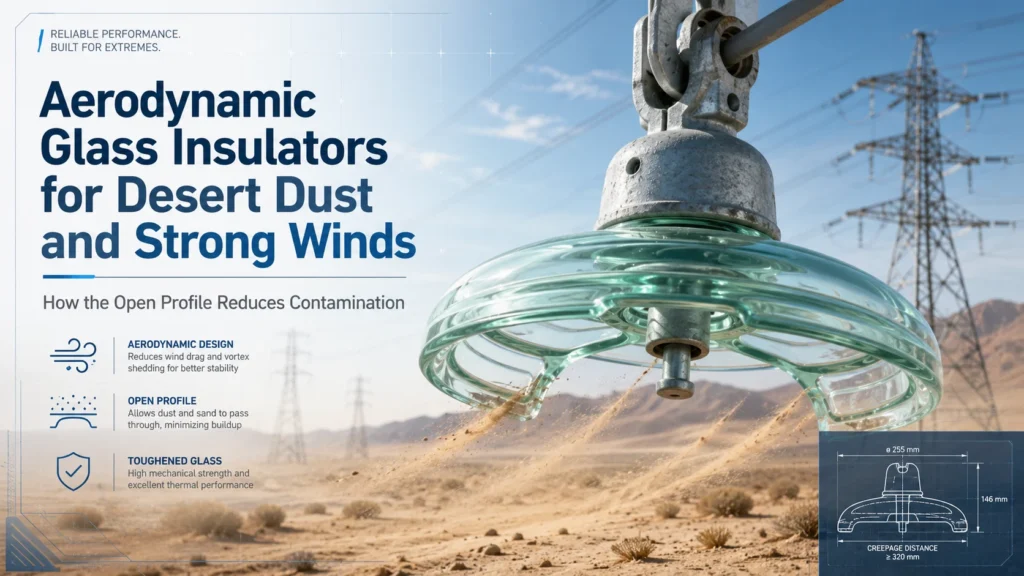
An aerodynamic glass insulator addresses a specific contamination problem: dry dust and sand collecting on suspension insulators in exposed, low-rainfall locations. Its open profile gives wind more access to the lower surface and reduces recessed areas where loose particles may settle. It can therefore suit desert transmission lines and other dry, wind-dominated routes. It is not a universal answer for salt fog, damp industrial deposits, mechanical wind loading, or every pollution-related flashover. Selection must connect the contaminant, weather pattern, insulator dimensions, system requirements, and replacement constraints.
Open-profile glass insulators are most relevant where contamination is mainly dry and particulate, such as mineral dust, sand, or construction dust. Strong prevailing winds, infrequent rain, and repeated dust exposure make the profile worth evaluating because the same airflow that transports particles may also remove material that has not bonded strongly to the surface.
Record the pollution source, prevailing wind direction, rainfall, humidity, seasonal sandstorms, and where deposits appear on the existing string. Review maintenance records, leakage-current trends, washing frequency, and event history.
An open profile may be less suitable when contamination becomes damp, sticky, saline, oily, or chemically conductive. Dew, fog, salt mist, industrial emissions, and high humidity can bond deposits to the surface and limit wind-driven cleaning. Those conditions may require a different profile, more creepage distance, a coating, or another material.
IEC TS 60815-1 and IEC TS 60815-2 treat pollution type, site severity, shed profile, dimensions, installation conditions, and verification as connected selection factors. Selection should not be reduced to a product name or one creepage-distance value.
Conventional disc profiles can contain ribs and sheltered recesses beneath the glass shell. An aerodynamic or open profile simplifies the lower surface so fewer protected areas are available for loose dust and sand to collect.
A 2026 CFD study of dry particulate deposition on glass-insulator strings found that local airflow, particle size, wind speed, and insulator geometry affect where contaminants settle. Deposition was nonuniform, with complex flow near the lower surface and wake regions. The study did not test the CECI product, but it supports the point that deposition depends on geometry and operating conditions.
Img.Aerodynamic glass insulator with open profile design for desert transmission lines and dust contamination control.webp
The aerodynamic glass insulators range uses an open design intended to limit dust and sand accumulation on the lower surface and support wind-assisted cleaning. Published models extend from U70BP through U300BP/195M, with model-specific mechanical, dimensional, coupling, creepage, and electrical fields. Suitability still requires drawing and specification checks.
Wind-driven cleaning is most plausible when particles are dry, loose, and exposed to airflow. It becomes less dependable when fine material enters sheltered flow zones or moisture creates a bonded layer. Particle size, turbulence, direction, and string position also affect deposition.
“Self-cleaning” should therefore mean reduced buildup under suitable conditions, not maintenance-free operation. Inspect both sides of the string, upper and lower surfaces, caps, pins, and fittings. Compare contamination before and after windy periods.
Dry mineral dust behaves differently from industrial pollution or coastal salt contamination. Review four variables:
An aerodynamic glass insulator for desert lines is a candidate when dry solid contamination and wind dominate. Damp or chemically active deposits require review of conductivity, profile, creepage, and testing.
| Profile | More relevant conditions | Conditions requiring caution | Buyer checks |
| Aerodynamic/open | Dry dust, sand, low rainfall, prevailing wind | Damp, saline, oily, or sticky deposits | Drawing, site evidence, dimensions, tests |
| Standard | Mild pollution and satisfactory field history | Repeated buildup or changed site conditions | Creepage, load, operating record |
| Fog/pollution | Wet or salt-related pollution | Mainly dry sand deposition | Wet requirements, profile, creepage |
| Double-shed | Different shed or creepage configuration required | Selection based only on “polluted area” | Diameter, height, spacing, coupling |
Naming varies by supplier. Compare sectional drawings, dimensions, electrical requirements, and stated application limits.
Repeated buildup does not prove a profile mismatch. Check whether contamination is concentrated beneath the discs, spread across the string, or collecting mainly on fittings. Review conditions before a flashover or leakage-current increase; sandstorms, dew, rain, or a changed pollution source may indicate different causes.
Inspection should also cover shattered units, damaged fittings, incorrect string length, reduced clearances, and maintenance gaps. If sheltered strings show heavier lower-surface deposits than exposed strings, geometry may matter. Damp conductive contamination may require another response.
Before replacement, review cleaning, monitoring, pollution-source control, and inspection timing. Where data is incomplete, consider a limited field evaluation.
After installation, document the new profile, inspect it through a representative dust season, and compare accumulation with the previous design. Confirm string length, clearance, fittings, and grading-hardware position.
A shared mechanical rating does not establish compatibility. Procurement teams should compare:
Similar model suffixes may describe different geometry across catalogs. Use the full designation and drawing, then verify each interface. CECI Gridinsulators publishes multiple aerodynamic models and specification fields, but selection still depends on line design and site conditions.
Include system voltage, AC or DC service, existing model, mechanical load, coupling, height, diameter, required creepage distance, altitude, orientation, quantity, destination, and governing standard.
Add the dust or sand source, rainfall, humidity, prevailing wind, seasonal storms, cleaning method, and known failure history. Drawings and photos of the string, deposits, and damaged units help distinguish dry dust from wet pollution.
A supplier should provide a clear profile drawing, dimensional data, mechanical and electrical specifications, model identification, and documents required by the purchasing specification. A useful review asks about the pollution mechanism and installed hardware before proposing a model. Red flags include broad “anti-dust” claims without site questions, missing coupling details, or claims that wind removes the need for cleaning.
CECI Gridinsulators presents glass insulators, composite insulators, and related power-grid products in its catalog. The about CECI Gridinsulators page provides company information, while the aerodynamic product page provides model-specific specification fields and an inquiry route.
The documented process includes first-article inspection before batch production and revalidation after changes to processes, molds, materials, or equipment. Contract-specific inspections and documents should still be requested.
Aerodynamic glass insulators are most relevant where dry dust or sand, prevailing winds, and limited rainfall create recurring lower-surface contamination. Their open profile can support wind-assisted cleaning, but selection still depends on wetting, particle behavior, creepage requirements, load, dimensions, and the applicable standard.
For a profile or replacement review, use contact the insulator team to submit the existing model, drawings, dimensions, mechanical rating, site photos, dust and weather conditions, quantity, and project specification. This supports compatibility review without assuming every dusty line needs the same profile.
The terms commonly describe the same general design direction, but supplier naming can vary. Confirm the sectional drawing, geometry, dimensions, coupling, and full model code.
Wind may remove loose dry particles, but results depend on particle size, direction, turbulence, moisture, adhesion, and string geometry. Inspection and maintenance planning remain necessary.
It should not be selected from the word “pollution” alone. Salt fog creates wet conductive contamination and may require a different profile, creepage arrangement, coating, or verification method.
Only after the mechanical rating, coupling, height, diameter, string length, creepage distance, electrical requirements, hardware, and clearances have been checked.
Provide the dust source, rainfall, humidity, prevailing wind, seasonal storms, altitude, existing model, maintenance records, failure photos, system requirements, and applicable standard.

 Room 1502, NO.12, Shangwu Waihuan Road, CBD, Zhengzhou, China
 +86-18937178812
 sales@gridinsulators.com


 September 17, 2026