what are you looking for?

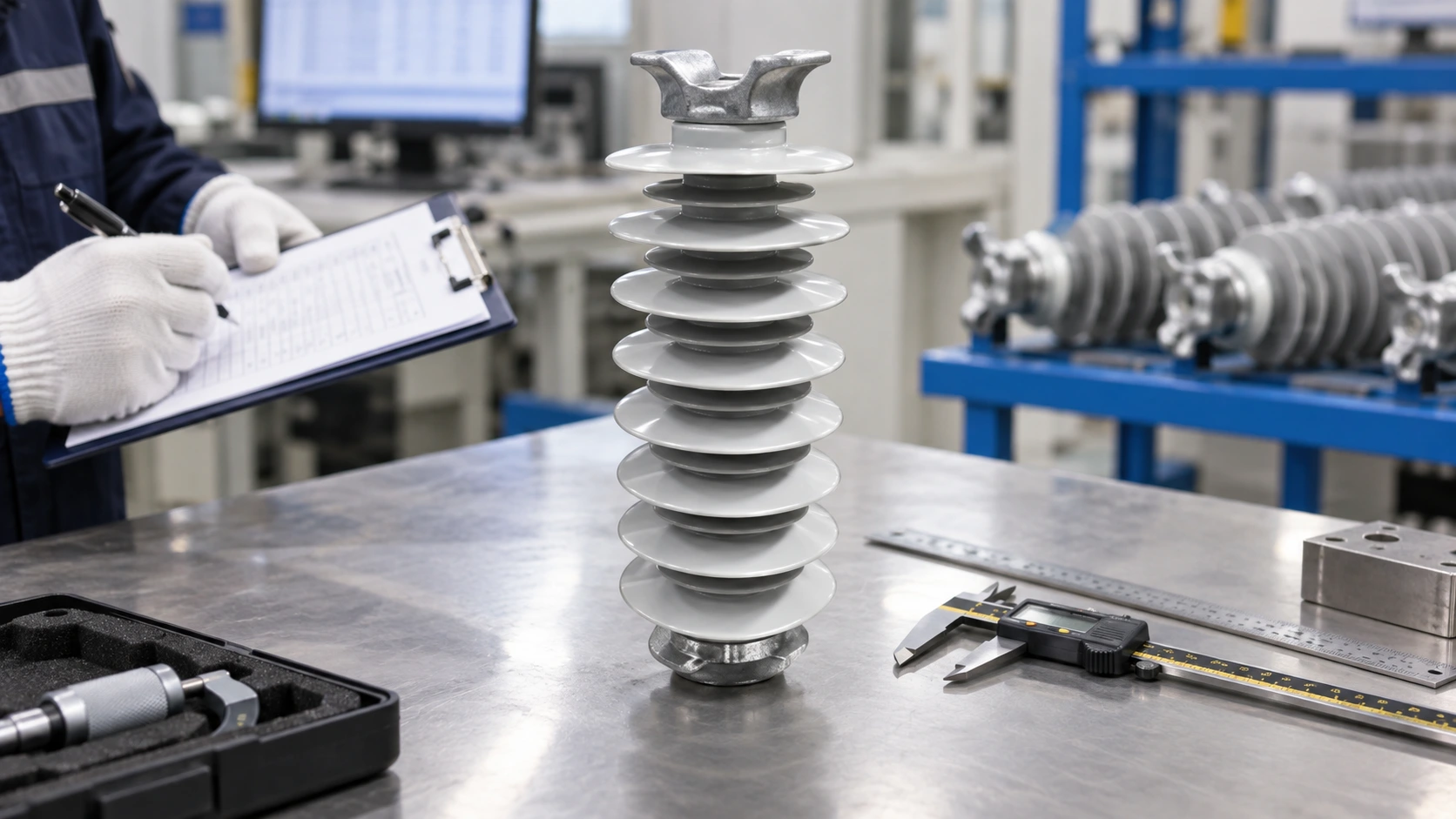
A first article inspection (FAI) is the approval point between an approved design and repeatable production. For composite insulators, the first unit or representative sample must show that the fiberglass core, silicone rubber housing, sheds, metal end fittings, dimensions, and manufacturing route work together as specified. Approval gives engineering, quality, and procurement teams a basis for releasing the batch and a trigger for re-validation when the process changes.
Composite insulators combine electrical insulation with a mechanical load path. The core rod carries tensile or bending loads, the polymer housing provides the weathering and hydrophobic surface, and the end fittings transfer force into the line hardware. A defect in one interface can remain hidden if the inspection looks only at the finished silhouette. That is why first article inspection for composite insulators should connect drawings, materials, dimensions, mechanical requirements, and process records in one approval package.
The review is especially valuable for a new voltage class, shed profile, fitting arrangement, or demanding coastal, industrial, desert, high-humidity, or railway application. Tests and acceptance limits depend on the approved design and project specification; the checklist below identifies what to confirm before volume release.
Start with a controlled drawing and a configuration record. The first article should be traceable to the revision that the customer approved, including the product type, rated voltage, mechanical failing load, creepage distance, arcing distance, shed diameter and spacing, core rod diameter, overall dimensions, color or surface requirements, and end-fitting type. If any value is missing from the drawing, it should be resolved before inspection rather than inferred from a similar model.
Verify drawing revision, bill of materials, part numbers, and customer purchase-order references.
Confirm the intended application: overhead transmission, distribution, substation, railway electrification, or industrial power system.
Record the required mechanical and electrical characteristics as acceptance criteria, not as informal notes.
This prevents a visually correct sample from being built to an obsolete drawing or adjacent model.
A composite insulator is a system of materials, not simply a polymer-covered rod. The FAI package should identify the FRP core, silicone rubber housing or sheds, metal end fittings, sealing materials, and associated hardware. Tie each material to a supplier lot, internal batch, certificate, or other agreed traceability record.
Inspectors should confirm that the core is the approved type and diameter, that the housing compound and color match the released specification, and that the fittings are made from the specified metal and surface treatment. For galvanized or coated components, the required coating condition and inspection method should be stated by the project documentation. Where a property depends on formulation, size, load, or environment, acceptance should remain conditional on the applicable specification rather than on a generic claim.
Examine the first article for defects affecting insulation, sealing, or load transfer. On the FRP core, look for damage, exposed fibers, abnormal marks, or dimensional variation. On the silicone rubber housing and sheds, check molding completeness, flash, cuts, voids, tears, contamination, uneven geometry, and surface defects. Use the approved inspection standard or drawing for visual limits.
Pay particular attention to the interface between the housing and the end fittings. The transition should be complete and sealed as designed, without visible gaps, displaced parts, or damage caused during crimping, compression, or assembly. Measure shed spacing, shed diameter, creepage-related dimensions, arcing distance, and overall length using calibrated equipment. A dimension that looks acceptable at one point can still create an installation problem when it shifts the coupling position or required clearance.
Metal end fittings determine how the insulator connects to suspension clamps, tension hardware, brackets, yoke plates, or other line components. The FAI should verify the fitting type, hole or pin dimensions, coupling geometry, orientation, and interface tolerances. A ball fitting must match its socket; a clevis must match the tongue, pin, and opening dimensions; an eye or other coupling must match the adjacent hardware shown on the assembly drawing.
Confirm that the fittings are fully seated, correctly aligned, and free from cracks, unacceptable deformation, sharp edges, or surface damage. Check the specified mechanical load path and ensure that the assembly method used for the first article is the same method intended for mass production. If the project requires arcing horns, clamps, brackets, or protective accessories, record them as part of the configuration rather than treating them as afterthoughts.
For related sourcing information, buyers can review CECI’s Overhead Line Hardware Fittings and Accessories and Polymer Insulators product range before issuing a project-specific request.
A first article approval should show how each critical requirement was checked. The record may include dimensional, visual, material, mechanical, electrical, or environmental tests required by the customer specification or applicable standard. Confirm that every test applies to the actual voltage, profile, load, and fitting configuration.
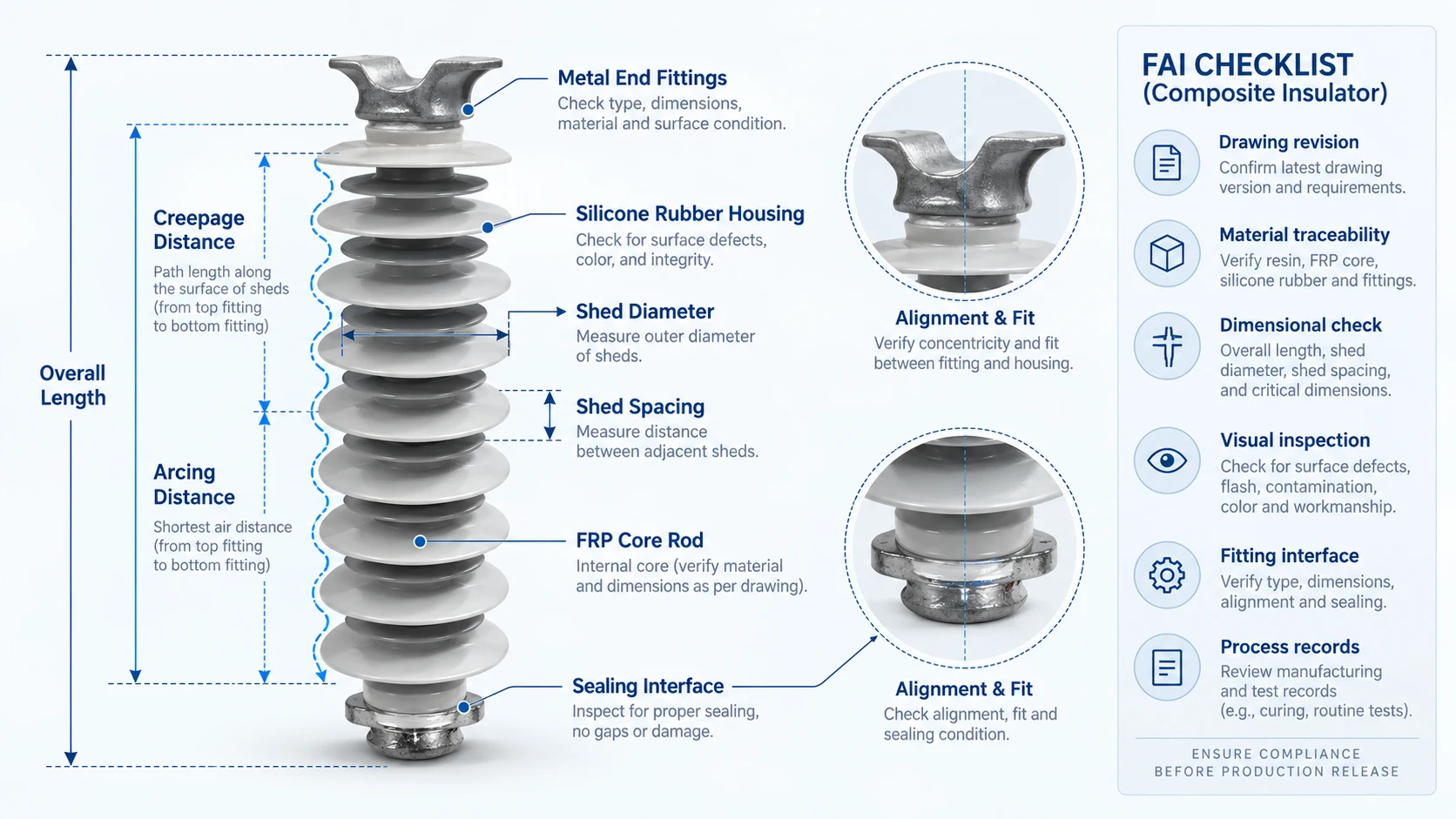
List the instrument or method used for each measurement and confirm calibration status.
Link every result to a drawing characteristic, test requirement, or acceptance criterion.
Separate measured results from statements that still require customer or laboratory confirmation.
Identify nonconformities, concessions, rework, and the documented disposition for each one.
The purpose is reproducibility: another qualified reviewer should see what was checked, against which requirement, and with what result.
FAI is also a manufacturing-readiness review. The production team should show that approved materials, molds, tooling, assembly sequence, molding conditions, fitting attachment, inspection points, and packaging are defined. The first article is not proof of repeatability if it used special handling unavailable during the batch.
Before mass production, confirm that work instructions and inspection plans identify core preparation, housing molding, fitting attachment, sealing, dimensional control, and final visual inspection. Define how samples will be retained and linked to the production lot, giving the quality team a baseline for in-process checks and future replacement orders.
The FAI approval remains valid while the approved configuration and process remain unchanged. Consider re-validation after a change to material, core, mold, fitting, tooling, equipment, supplier, assembly method, or a performance-critical dimension. The extent depends on the change and governing specification; document the decision.
A release record should state the approved revision, production batch, inspection date, reviewers, open actions, and events requiring re-approval. This matters for long-life outdoor networks, where an undocumented change can complicate failure analysis or replacement matching.
Before authorizing mass production, the buyer should receive a risk-appropriate approval package: released drawing, bill of materials, dimensional report, traceability records, visual inspection, required tests, nonconformance dispositions, and change-control statement. Mark items as approved, conditional, or requiring customer or third-party review.
CECI China Energy and Chemical Industry Co., Ltd. presents composite insulators for transmission and distribution applications, with supporting metal end fittings, arcing horns, mounting hardware, suspension clamps, connectors, and brackets. Selection still depends on voltage, mechanical load, creepage and arcing distances, dimensions, fitting interface, and operating environment. A technical review using those inputs is more useful than a product name alone.
First article inspection for composite insulators should answer one practical question: does the approved design, as actually manufactured, meet the requirements that matter in service and can it be reproduced consistently? Approve the configuration, materials, interfaces, dimensions, fittings, records, process controls, and change triggers before releasing mass production. When requesting a quotation or first-article review, provide the model or drawing, rated voltage, mechanical load, creepage and arcing requirements, fitting details, quantity, operating environment, and required documentation. You can contact the CECI technical team for a fit check and project-specific quotation.
It is a documented inspection and approval of the first representative unit or sample made to an approved design before repeat production. It connects the drawing, materials, measurements, tests, and manufacturing process.
No. FAI establishes the approved baseline. In-process and final inspections are still needed to confirm that subsequent units remain within the released requirements.
Changes to materials, suppliers, molds, tooling, equipment, fitting design, assembly method, or critical dimensions may require re-validation. The extent depends on the change and the applicable project specification.
Include the drawing or model, voltage, mechanical load, creepage and arcing distances, dimensions, end-fitting interface, quantity, environment, standards or customer requirements, and the records expected with the first article.

 Room 1502, NO.12, Shangwu Waihuan Road, CBD, Zhengzhou, China
 +86-18937178812
 sales@gridinsulators.com


 September 24, 2026