what are you looking for?

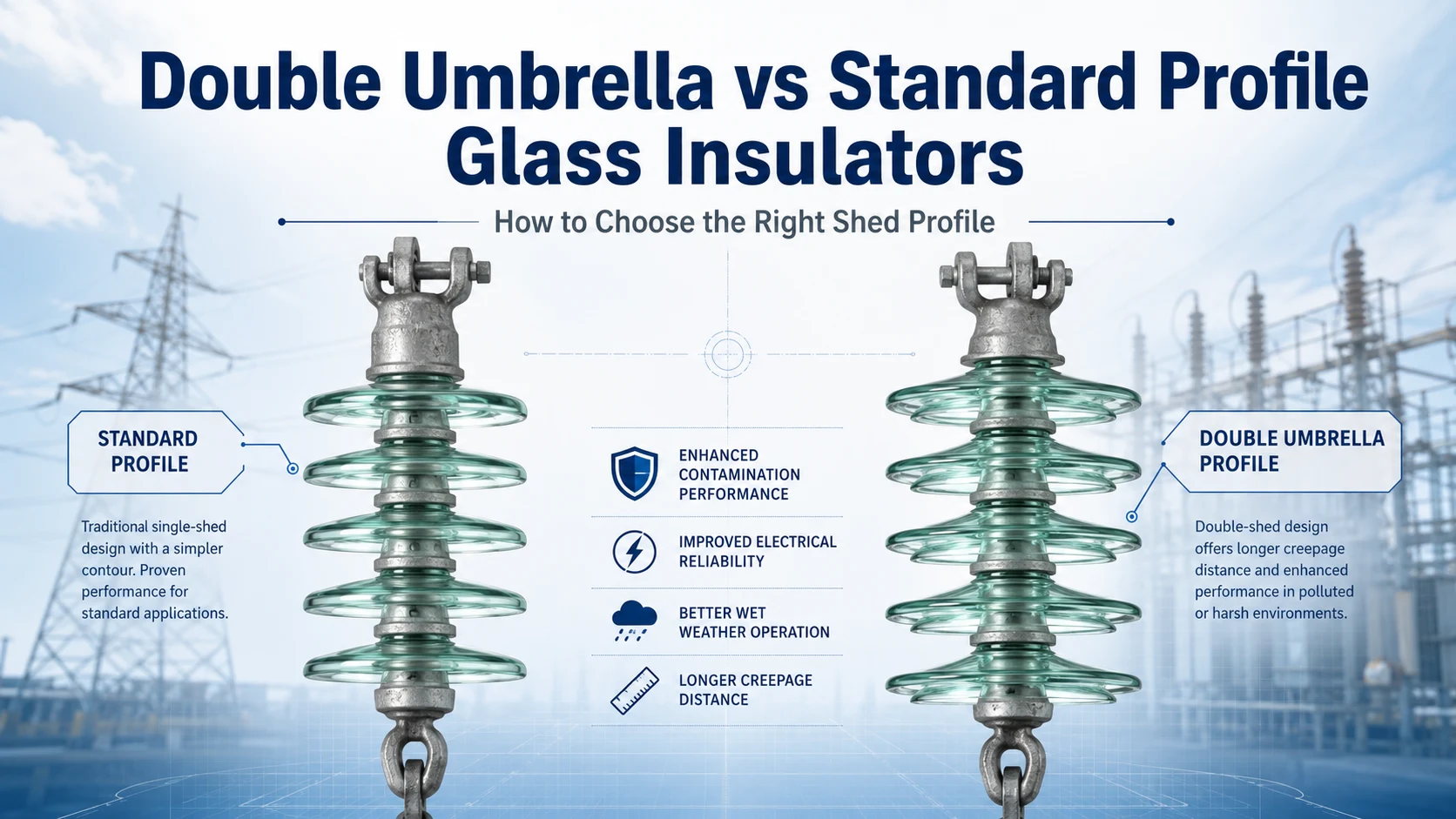
Choosing between double umbrella and standard profile glass insulators is not simply a matter of selecting the disc with the longer creepage distance. The correct choice depends on site pollution, wetting, natural cleaning, mechanical requirements, string geometry, and the applicable project standard. For engineers and B2B buyers, the real question is when shed profile materially changes expected performance and when a standard design is already suitable.
IEC 60815 treats site pollution severity, profile suitability, creepage-distance correction, dimensions, installation position, and verification testing as connected parts of the selection process.
A standard profile is usually the starting point where pollution is limited, rain or wind provides regular cleaning, and operating experience is satisfactory. A double-umbrella profile deserves closer evaluation where solid contamination accumulates, washing is difficult, or the project requires a different combination of exposed sheds and creepage distance.
| Selection factor | Standard profile | Double-umbrella profile |
|---|---|---|
| Typical condition | Clean to moderately polluted service with proven field history | Pollution deposition, wetting, or limited cleaning creates added concern |
| Main benefit | Familiar dimensions and straightforward replacement planning | Different shed geometry and potentially greater creepage distance |
| Main risk | Underestimating changed site conditions | Assuming “anti-pollution” wording fits every site |
| Required check | Existing performance, load, creepage, and string design | Pollution type, drawing, dimensions, tests, and compatibility |
Projects still defining voltage class or application requirements should review how to match glass insulators to applications before choosing a shed profile.
Pollution becomes electrically significant when contaminants collect on the glass surface and are wetted by fog, dew, drizzle, or salt mist. Shed geometry influences where contaminants settle, which surfaces receive wind and rain, and how moisture moves across adjacent areas.
“Harsh environment” is therefore too broad for selection. Coastal salt, industrial dust, desert sand, and agricultural deposits do not create identical conditions. Buyers should identify the contaminant, wetting frequency, rainfall, wind exposure, cleaning access, and any history of pollution-related events. A double-shed unit may be worth evaluating where its geometry addresses the observed pattern, but it cannot replace site assessment.
Creepage distance is an essential specification for polluted service, but it is not the only relevant dimension. Diameter, spacing, shed projection, installation position, and string configuration can affect how effectively the nominal path is used.
IEC TS 60815-2:2025 includes corrections for insulator shape, size, position, altitude, and shed profile when moving from a reference value to a candidate design. It also calls for verification when required. Buyers should request a full drawing and data sheet rather than comparing models by creepage distance alone.
A standard profile remains a sound choice when the existing line has acceptable service history, pollution severity has not increased, and the required electrical and mechanical ratings can be met without a special profile. It may also be preferable when one-for-one replacement matters and the installed string and clearances were designed around standard discs.
CECI gridinsulators lists standard-profile U100B and U120B glass insulators with a 255 mm diameter, 146 mm spacing, 320 mm creepage distance, and mechanical failing-load options of 100 or 120 kN. These values support specification matching, but project suitability still depends on the complete string design and operating conditions.
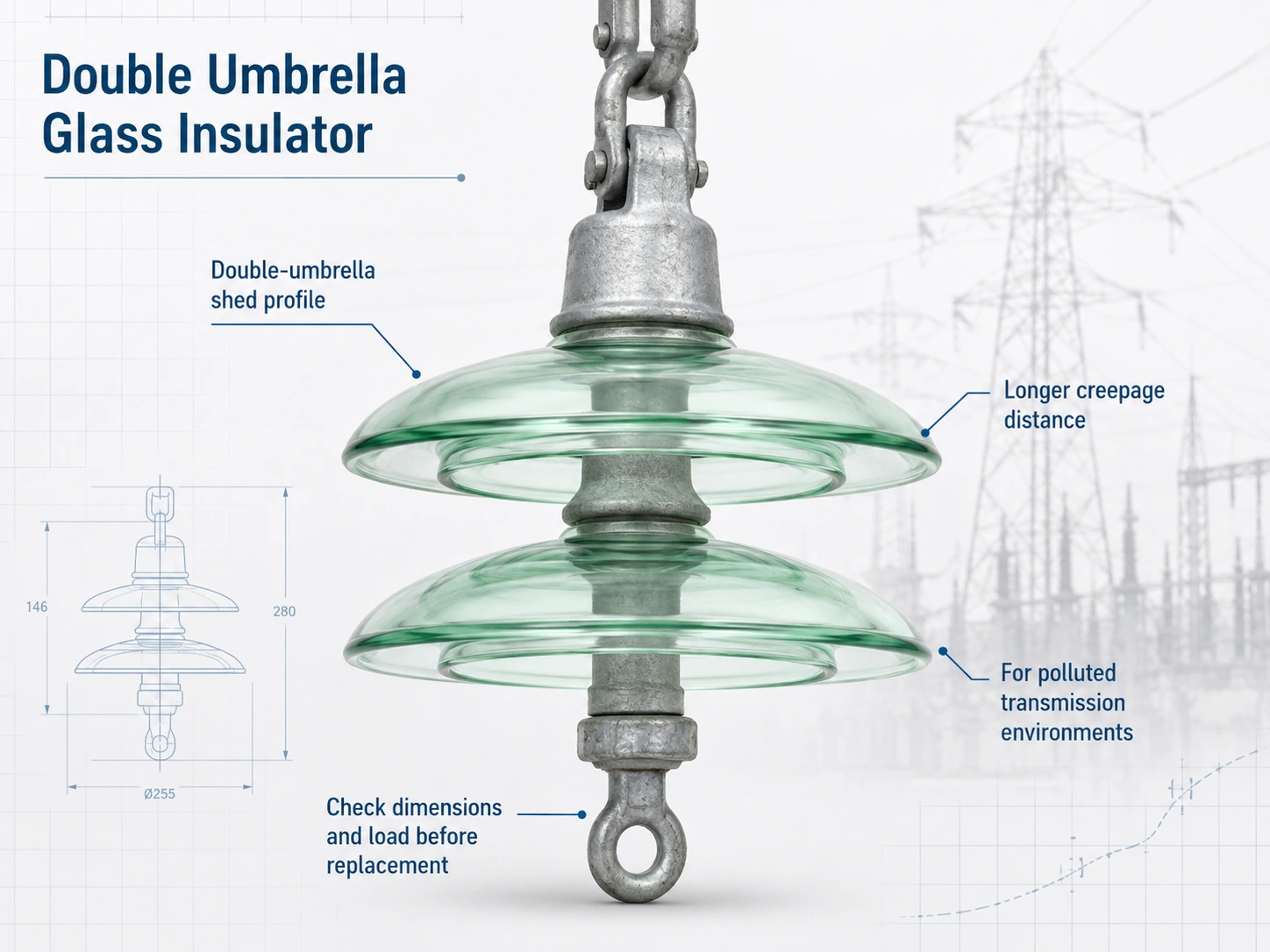
A double-umbrella profile should be evaluated when site evidence shows persistent contamination, limited natural washing, or a need for a different surface geometry and creepage arrangement. The decision should be based on pollution characterization and engineering review, not on the product name alone.
The CECI double umbrella glass insulators range includes UG-series units across several mechanical ratings. Published UG100B and UG120B data show 280 mm nominal diameter, 146 mm nominal structure height, and 450 mm creepage distance. Compared with the standard example, this shows that available designs differ in profile and dimensions; it is not a controlled pollution-performance comparison.
Confirm that the profile suits the contaminant and wetting mechanism, that its diameter fits available clearances, and that test evidence applies to the requested configuration.
Double umbrella, fog-type, aerodynamic, coated, and composite solutions should not be treated as interchangeable labels. DC service, ice, unusual installation positions, or extreme pollution can also need separate engineering treatment.
Review the wider glass suspension insulators range when neither geometry is an obvious fit, then check the choice against project drawings and required testing.
A flashover, abnormal leakage-current record, or repeated contamination event does not automatically prove that the installed profile is wrong. Determine when the event occurred, whether fog, dew, rain, or a long dry period preceded it, and whether nearby strings experienced the same condition. Inspect damaged units, contaminated hardware, grading components, clearances, and nearby environmental changes.
Before ordering replacements, compare the installed model, string creepage distance, mechanical rating, unit count, coupling, and tower geometry with the design requirements. If the cause is inadequate cleaning, damaged hardware, or a new pollution source, replacing standard discs without correcting that issue may not prevent recurrence.
Prevention can include inspections after known pollution periods, cleaning based on site conditions, weather and event records, and a review of whether the original pollution classification remains valid. Where evidence is incomplete, use a project-specific assessment rather than full replacement based on catalog terminology.
After a profile change, verify string length, clearances, fitting engagement, grading hardware, and the inspection plan.
Mechanical rating alone does not establish interchangeability. Compare mechanical failing load, connection size, structure height, diameter, weight, creepage distance, dry arcing distance, and electrical withstand values. Also review total string length, tower-window clearance, conductor position, and fittings.
A 100 kN standard disc and a 100 kN double-umbrella disc may share a load class while having different dimensions. Replacement approval should be based on a matched drawing and specification, not only a familiar model prefix or load value.
A useful RFQ should state:
system voltage and AC or DC application;
existing model, photos, drawings, and coupling;
mechanical load, unit spacing, diameter, and target creepage distance;
pollution type, humidity, rainfall, altitude, and cleaning conditions;
applicable IEC, ANSI, utility, or project specification;
quantity, destination, inspection documents, and testing requirements.
This helps identify conflicts before quotation and reduces the risk of receiving a dimensionally unsuitable product.
A qualified supplier should provide a traceable model designation, dimensional drawing, electrical and mechanical data, applicable test documentation, and a clear explanation of how the proposed profile relates to site conditions. Warning signs include vague “anti-pollution” claims, missing coupling dimensions, inconsistent names, or a recommendation made without asking about pollution and wetting.
CECI gridinsulators supplies glass, composite, and related power-line products through CECI gridinsulators and publishes dimensional and performance fields for its glass-insulator range. Its documented quality process includes first-article inspection before batch production and revalidation when processes, molds, materials, or equipment change.
Double umbrella vs standard profile glass insulators should be selected by connecting pollution, wetting, natural cleaning, creepage requirements, mechanical loading, and installation geometry. Standard profiles are often appropriate where service history supports them. Double-umbrella designs merit evaluation where contamination behavior or required dimensions justify a different shed arrangement.
For a profile or replacement review, submit the existing model, photos or drawings, system type, mechanical load, dimensions, pollution conditions, target quantity, and applicable standard. This supports a practical comparison without assuming one profile is universally preferable.
The terms are often used for similar products, but naming varies. Confirm the profile drawing, dimensions, creepage distance, coupling, and model designation.
No. Suitability depends on the contaminant, wetting, natural cleaning, maintenance access, and complete insulation design.
No. Profile geometry, diameter, spacing, installation position, site severity, and verification requirements also matter.
Only after confirming load, coupling, unit height, diameter, string length, clearances, electrical values, and project approval.
Provide system voltage, AC or DC service, the current model and drawing, mechanical load, dimensions, site conditions, standard, quantity, and required test documents.

 Room 1502, NO.12, Shangwu Waihuan Road, CBD, Zhengzhou, China
 +86-18937178812
 sales@gridinsulators.com


 September 24, 2026